Total Solar Eclipse 2026 in Spain — Where & How to Watch on August 12
Total solar eclipse Aug 12, 2026 in Spain: path of totality, best cities (Oviedo, Burgos, Zaragoza, Valencia, Palma), timings, safety and travel tips.
Key takeaways
- The total solar eclipse of August 12, 2026 crosses northern Spain from Galicia to the Balearic Islands.
- It is the first total eclipse over the Spanish mainland since 1905 — 121 years of waiting.
- Totality peaks at 20:26–20:33 CEST, with the Sun low over the western horizon (up to ~1m49s in Oviedo).
- Madrid and Barcelona see only a ~99% partial eclipse — you must travel into the path of totality.
- Never look at the Sun without certified ISO 12312-2 eclipse glasses, except during the brief moments of totality.
Total Solar Eclipse 2026 in Spain — Where & How to Watch on August 12
On Wednesday, August 12, 2026, the Moon’s shadow will sweep across northern Spain, turning late-afternoon daylight into twilight for up to nearly two minutes. It is the first total solar eclipse visible from the Spanish mainland since 1905 — a 121-year wait — and one of the biggest travel events of 2026. Here is everything you need to know: the exact timings, the best places to stand, how to stay safe, and how to turn the trip into an unforgettable Spanish holiday.
Why the August 12, 2026 eclipse is a once-in-a-generation event
A total solar eclipse happens when the Moon passes exactly between the Sun and the Earth, blocking the Sun’s disk completely and revealing its delicate corona — the only time you can see it with the naked eye. While partial eclipses are common, totality is rare: the narrow shadow band, about 290 kilometres wide, touches a given spot on the planet roughly once every 375 years on average. Spain’s last taste of totality was 1905, long before mass tourism, so the 2026 event is drawing astronomers, photographers and travellers from across the planet.
What makes this eclipse unique is its timing. The shadow arrives at sunset, so the Sun hangs low — between 2° and 12° above the western horizon. That means two things: the show ends with an extraordinary “eclipsed sunset”, but you need an unobstructed view to the west to see it. A ridge, a building or a line of trees can hide the entire event.
Key facts: date, times and the path of totality
The umbra makes landfall on the Atlantic coast of Galicia at about 20:27 CEST, races southeast across Asturias, Cantabria, Castile and León, La Rioja and Aragón, clips the Valencian coast and finishes over the Balearic Islands before sunset.
| City | Totality duration | Maximum | Sun altitude |
|---|---|---|---|
| A Coruña (Galicia) | 1m 17s | 20:28 | ~12° |
| Oviedo (Asturias) | 1m 49s | 20:28 | ~10° |
| Santander (Cantabria) | 1m 03s | 20:27 | ~9° |
| Valladolid (Castile-León) | 1m 28s | 20:30 | ~8° |
| Burgos (Castile-León) | 1m 44s | 20:29 | ~8° |
| Zaragoza (Aragón) | 1m 24s | 20:29 | ~6° |
| Valencia (Valencian Community) | 1m 00s | 20:33 | ~4° |
| Palma de Mallorca (Balearics) | 1m 36s | 20:31 | ~2° |
Arrive at your viewing spot at least two hours before first contact — roads and vantage points fill up fast on eclipse day.
Madrid and Barcelona: deep partial, not totality
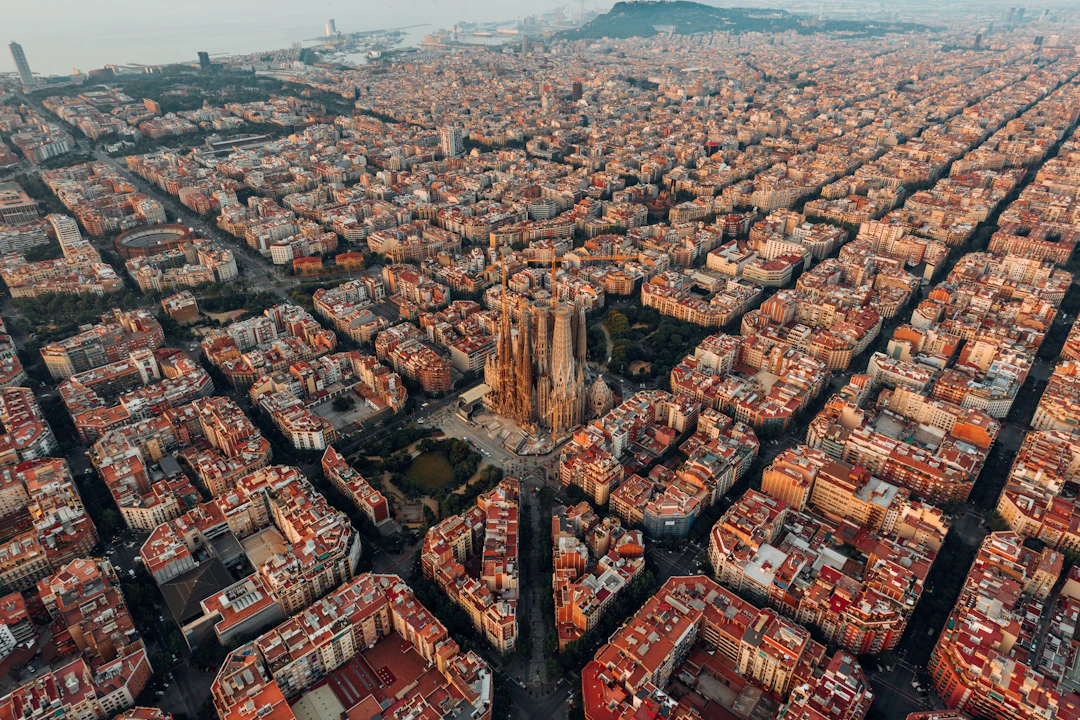
If you are staying in Madrid or Barcelona, here is the uncomfortable truth: both cities sit just outside the path and will experience a 99.9% partial eclipse. That sliver of uncovered Sun keeps the sky bright, hides the corona and turns what should be a jaw-dropping moment into a slightly dimmer afternoon. The difference between 99% and 100% is the difference between night and day — literally.
The good news: the edge of totality lies close. From Madrid, about an hour’s drive north (towards Segovia, Valladolid or Soria) puts you inside the band. From Barcelona, head west to Zaragoza or south along the coast towards the north of Valencia. If you can only travel one hour, do it — thousands will be making the same drive, so leave early.
The best places to watch totality in Spain
Choosing a viewing site means balancing three things: longer totality (closer to the central line), clear August skies, and an open western horizon. Here are our top picks, region by region.
Asturias (Oviedo and Gijón) — longest totality on the mainland
The central line passes right through Oviedo and Gijón, giving up to 1 minute 49 seconds of totality — the maximum on the peninsula. The Cerro de Santa Catalina in Gijón offers a coastal viewpoint, while the Naranco hills above Oviedo let you climb above the evening sea fog. The trade-off: the Cantabrian coast has roughly a 30–50% chance of clear skies in August.
Castile and León (Burgos, Palencia, Valladolid) — clearest skies
If clear skies are your priority, the high plains of Castile and León are statistically the safest bet, with 70–85% probability of clear weather in mid-August. Burgos, near the central line with 1m44s of totality, is our pick: the flat páramos west of the city offer perfectly open horizons, and the famous Gothic cathedral is a superb backdrop for your pre-eclipse afternoon.
Teruel and the Javalambre Observatory — a dark-sky reserve
The province of Teruel combines a long totality (~1m34s) with some of Europe’s lowest light pollution. The Javalambre Astrophysical Observatory in the Sierra de Gúdar-Javalambre sits in a certified Starlight Reserve, and the European Space Agency is expected to broadcast the eclipse from here. Perfect for astrophotographers.
La Rioja and the Ebro Valley — wine country with a view
Logroño, capital of Spain’s wine country, delivers ~1m22s of totality with dry, reliable weather and temperatures that stay below the meseta’s 35°C afternoon peaks. Pair the eclipse with a winery visit — La Rioja’s vineyards are famous worldwide.
Valencia and the Ebro Delta
Valencia is on the southern edge of the path with a shorter 1 minute of totality, but the flat horizons of the Albufera lagoon and the beaches are convenient for a city break. The Ebro Delta Natural Park in Catalonia is one of the few east-coast spots with a clear sightline to the low Sun.
Mallorca (west coast and Palma) — a Mediterranean finale
For a holiday-and-eclipse combination, Palma de Mallorca delivers 1m36s of totality over the Mediterranean, just ten minutes before sunset. The north coast — Port de Pollença and Alcúdia — sits on the central line with open views to the west, and August is the driest, most reliable month for clear skies in the Balearics. Book accommodation now; August is peak season.
Galicia (A Coruña) — where it all begins
A Coruña is the first Spanish city to see the shadow, with 1m17s of totality beside the Roman-era Tower of Hercules lighthouse. Atlantic clouds are a real risk (30–50% clear), so have a Plan B inland towards Lugo.
Eclipse safety: your eyes matter more than your gear
Never, ever look at the Sun without certified eclipse glasses — not through sunglasses, phone cameras, binoculars or telescopes. Use glasses marked ISO 12312-2 and check the filters for scratches. The one exception is the brief totality window, when the Sun is fully covered and it is safe to look with the naked eye — that is when you’ll see the corona and the famous “diamond ring”. The moment totality ends, glasses go straight back on. Thousands of people have damaged their eyesight by ignoring this rule; don’t be one of them.
Weather: where the clouds are (and aren’t)
Mid-August statistics strongly favour the east and the interior. The Balearic Islands have only a ~15% cloud risk; the Mediterranean coast around 30%; Castile and León, La Rioja and Aragón roughly 15–30%; while the Cantabrian and Galician coasts are the riskiest at 50–75%. Stay mobile — the path is wide and well served by roads, so a short drive a few hours before maximum can put you under a clear sky.
Travel logistics for eclipse day
Expect major congestion in every town inside the path on August 12. Arrive at your spot two hours early, park before noon if you can, carry water and food, and check the weather forecast on the morning of the event before committing to a location. A day-use backpack, a refillable bottle and comfortable shoes will make the difference between enjoying the show and suffering it. More planning tips are waiting in our travel tips.
What to pack for eclipse day
A total eclipse is a waiting game — you’ll be outside in the late afternoon sun, then in sudden twilight. Pack light and smart:
- Foldable Travel Daypack (16,90 €) — stash your layers, water and picnic for the two-hour wait.
- Collapsible Silicone Water Bottle (13,90 €) — stay hydrated in the Spanish heat.
- Universal Travel Adapter (15,90 €) — keep your phone charged to film the corona.
- Noise-Cancelling Earplugs (12,90 €) — for restful nights after long travel days.
- Lightweight Walking Sandals (19,90 €) — comfortable for the walk to your viewpoint.
- RFID-Blocking Travel Wallet (11,90 €) — keep documents safe in the crowds.
Extend your trip: Spain beyond the eclipse
A flight to Spain for a two-minute event deserves a proper holiday around it. Pair the eclipse with our full city guides: explore Barcelona’s architecture and beaches, wander Madrid’s museums and plazas, taste paella in Valencia, discover Moorish Granada and the Alhambra, or enjoy the tapas culture of Seville. If you want a quieter, slower escape afterwards, our guide to the best slow-travel destinations of 2026 is a great starting point — and eclipse fans will love that Iceland, our guide to Reykjavik, also sees a deep partial eclipse the same evening.
External resources
- NASA: Total Solar Eclipse on August 12, 2026 — official path map and timings
- Time and Date: Eclipse in Spain — interactive city timings
- Space.com: 10 incredible places to see the eclipse — expert viewing picks
- AEMET — Spain’s official weather service, essential for eclipse-day planning
You might also like
New products coming soon.